Larch Creek Birds
What the birds (and frogs) are saying at a creek in western Washington

Bird
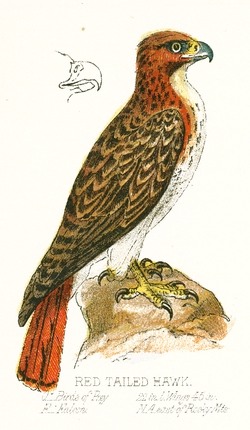
Red-tailed Hawk
Buteo jamaicensis
Hawks, Eagles, and Kites (Accipitridae)
Year-round resident. Expected at the creek in every month.
- Field marks
- A broad-winged, broad-tailed hawk. Adults have a brick-red tail and most show a dark belly band; western birds come in every shade from pale to nearly black, like a hawk that could not decide.
- Male & female
- Alike; females are about a quarter heavier.
- Voice
- A harsh, descending scream, 'keeeeer', the sound every film uses for every raptor, including eagles, which are too dignified to make it.
- Diet
- Mostly rodents and rabbits, plus snakes and birds; hunts from a perch or a slow circling soar.
- Habitat
- Open country with scattered trees, forest edges, the big trees beside highways.
- Nesting
- A big stick nest high in a tall tree or on a cliff, reused for years and renovated every spring; 2–3 eggs.
- Size
- 18–26 in long, wingspan 3½–4½ ft, 1½–3 lb: the wingspan of a yardstick and a bit, the weight of a hardcover dictionary.
A Steller's Jay can imitate this scream almost perfectly, so a 'hawk' calling from inside a dense conifer may be a jay enjoying itself.
Season how expected it is here, week by week
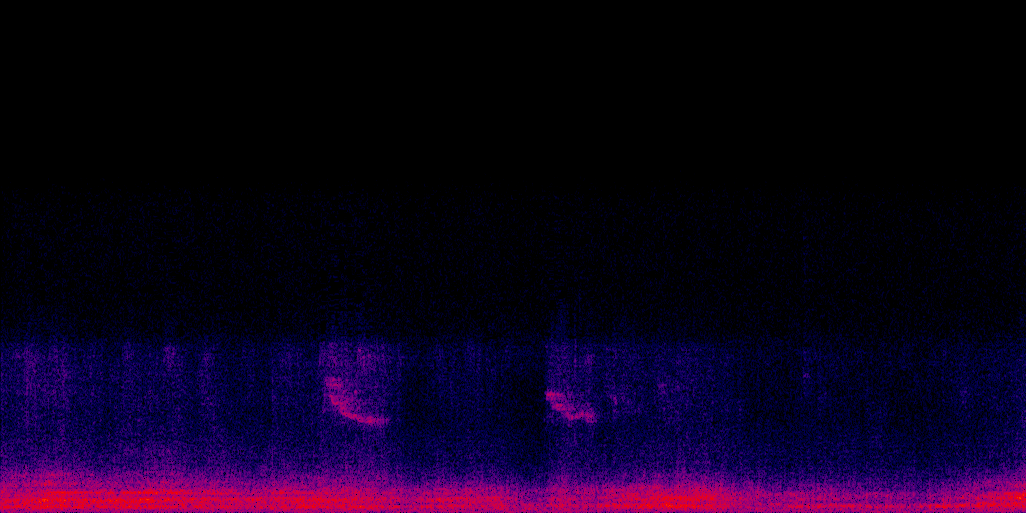
At the creek 1 calls on 1 day, first Oct 29, last Oct 29
Recordings
Clearest recording · Oct 29 10:36 am · 96% sure
From the encyclopedia
The red-tailed hawk is a bird of prey and one of the most common hawks in North America. In the United States, it is one of three species colloquially known as the "chickenhawk". The red-tailed hawk breeds throughout most of the continent, from western Alaska and northern Canada to as far south as Panama and the West Indies. The red-tailed hawk occupies a wide range of habitats and altitudes, including deserts, grasslands, coniferous and deciduous forests, agricultural fields, and urban areas. It is absent in areas of unbroken forest and in the high arctic. It is legally protected in Canada, Mexico, and the United States by the Migratory Bird Treaty.
From Wikipedia, "Red-tailed hawk", CC BY-SA 4.0.