Larch Creek Birds
What the birds (and frogs) are saying at a creek in western Washington
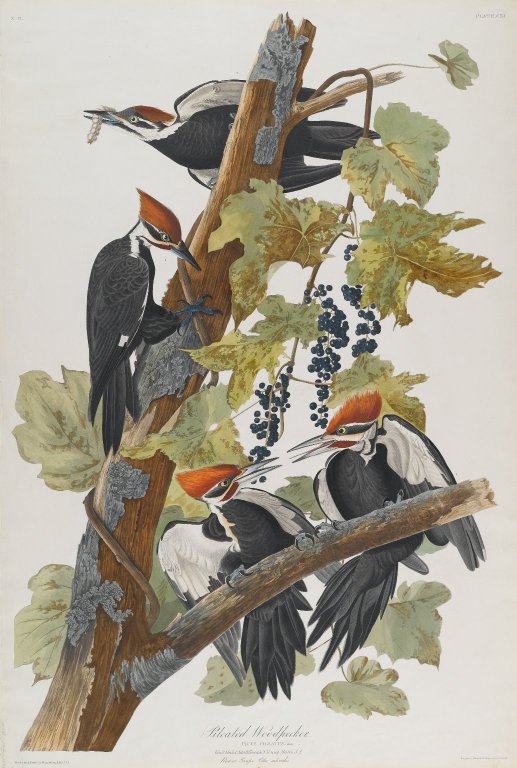

Bird
Pileated Woodpecker
Dryocopus pileatus
Woodpeckers (Picidae)
Year-round resident. Expected at the creek in every month.
- Field marks
- A crow-sized woodpecker, black with a flaming red crest, white neck stripes and white underwings that flash in flight. The bird the cartoon was based on, and not much exaggerated.
- Male & female
- The male has a red forehead and red moustache stripe; the female's forehead is black and her moustache is black.
- Voice
- A loud, wild 'kuk-kuk-kuk-kuk' laugh and slow, heavy drumming that carries through the woods like someone building a shed.
- Diet
- Carpenter ants and beetle larvae dug from dead wood, plus berries.
- Habitat
- Mature forest with big dead trees and downed logs.
- Nesting
- A deep cavity in a large dead tree, freshly excavated each year; 3–5 eggs. Last year's hole becomes someone else's house.
- Size
- 16–19 in long, 9–12 oz: a crow-sized bird of about a can of beans, with a hammer for a face.
Look for its signature: rectangular holes chiselled into rotten stumps, with a pile of fresh chips below, as if a tiny carpenter had left in a hurry.
Season how expected it is here, week by week
At the creek 5 calls on 2 days, first Oct 30, last Oct 31
Recordings
Clearest recording · Oct 31 8:26 am · 100% sure

Recent · Oct 31 6:59 pm · 89% sure

Recent · Oct 31 8:27 am · 93% sure

Recent · Oct 30 8:46 am · 98% sure

From the encyclopedia
The pileated woodpecker is a large, crow-sized woodpecker with a prominent red crest, white neck stripe, and a mostly black body. This woodpecker is native to North America, where it is the largest confirmed extant woodpecker species and the third-largest extant species of woodpecker in the world, after the great slaty woodpecker and the black woodpecker. It inhabits deciduous forests in eastern North America, the Great Lakes, the boreal forests of Canada, and parts of the Pacific Coast. This woodpecker is primarily an insectivore, eating insects that live in trees; it is famous for making large, nearly rectangular carvings into trees, which are used to extract prey inside the tree or to make a nest. The species has a large range and an increasing population, causing it to be categorized as a species of "least concern" by the IUCN.
From Wikipedia, "Pileated woodpecker", CC BY-SA 4.0.