Larch Creek Birds
What the birds (and frogs) are saying at a creek in western Washington
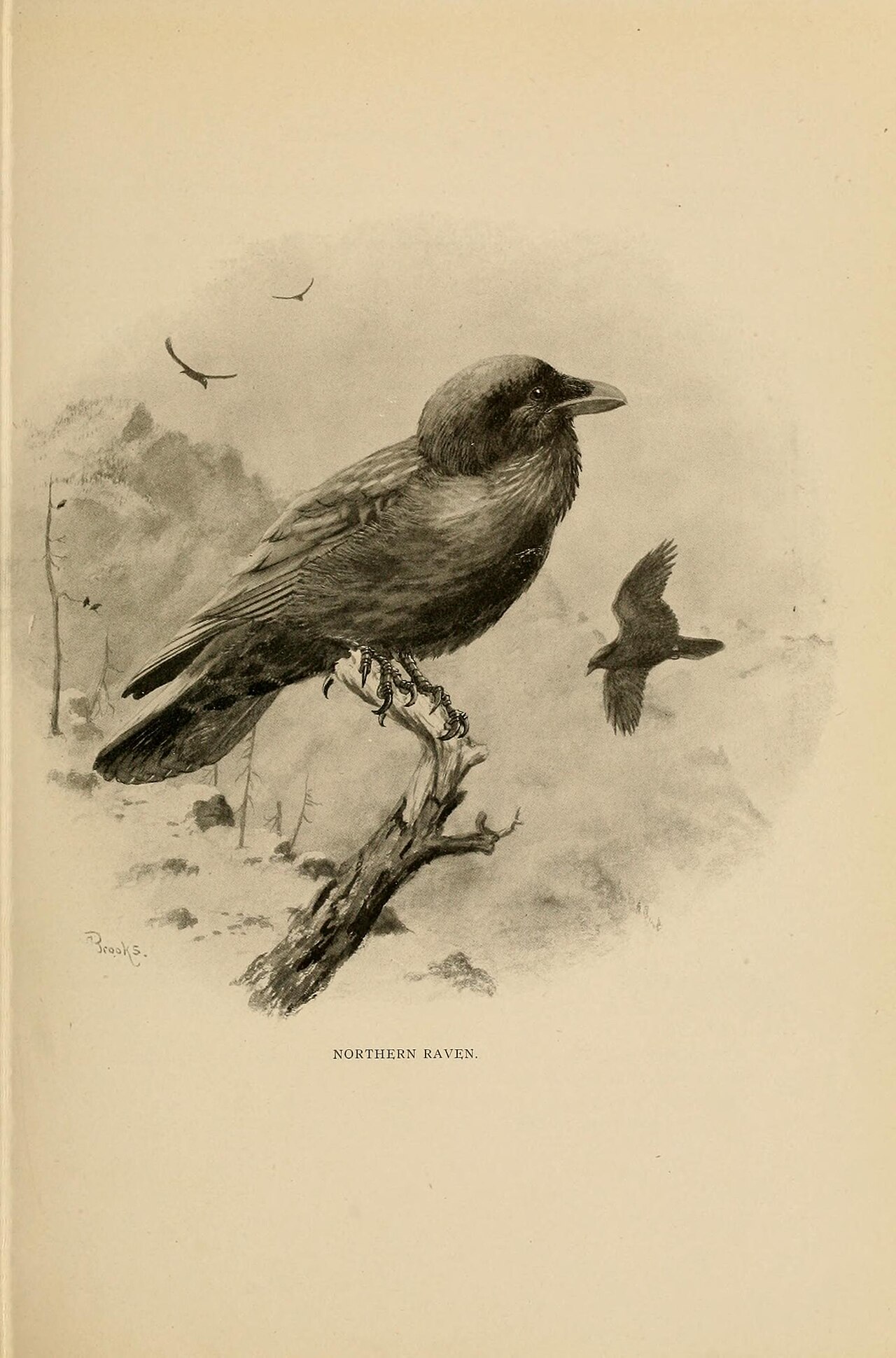

Bird
Common Raven
Corvus corax
Crows, Jays, and Magpies (Corvidae)
Year-round resident. Expected at the creek in every month.
- Field marks
- A huge, glossy black corvid with a wedge-shaped tail, shaggy throat feathers and a heavy bill. Soars, tumbles and flies upside down for fun in a way crows never do.
- Male & female
- Alike; males average larger.
- Voice
- Deep croaks, hollow knocking 'tok-tok', bell-like notes and gurgles: a vocabulary of several dozen sounds, most of them commentary.
- Diet
- Carrion first, then anything: small animals, eggs, grain, berries, garbage, and the lunch of anyone who looks away.
- Habitat
- Forests, mountains, coasts; in the Puget lowlands wherever big conifers and a bit of wild country remain.
- Nesting
- A large stick nest on a cliff or in a tall conifer, reused for years; 3–7 eggs laid as early as February.
- Size
- 22–26 in long, a 4-ft wingspan, 1½–3½ lb: the weight of a hefty laptop, and rather better at problem-solving.
Ravens mate for life and a pair patrols its territory year-round, so the same two birds are likely behind most of the croaking at the creek. They will have noticed the microphone.
Season how expected it is here, week by week
At the creek 96 calls on 4 days, first Oct 28, last Oct 31
Recordings
Clearest recording · Oct 29 5:03 pm · 99% sure

Recent · Oct 31 9:04 pm · 91% sure

Recent · Oct 31 6:12 pm · 87% sure

Recent · Oct 31 5:04 pm · 89% sure

From the encyclopedia
The common raven or northern raven is a large all-black passerine bird. It is the most widely distributed of all corvids, found across the Northern Hemisphere. There are 11 accepted subspecies with little variation in appearance, although recent research has demonstrated significant genetic differences among populations from various regions. It is one of the two largest corvids, alongside the thick-billed raven, and is the heaviest passerine bird; at maturity, the common raven averages 63 centimetres in length and 1.47 kilograms in weight, up to 2 kg (4.4 lb) in the heaviest individuals. Although their typical lifespan is considerably shorter, common ravens can live more than 23 years in the wild. Young birds may travel in flocks but later mate for life, with each mated pair defending a territory.
From Wikipedia, "Common raven", CC BY-SA 4.0.